Reiki as it is taught today goes back to Mikao Usui, who began teaching it in Tokyo in 1922. From Usui it passed to Chujiro Hayashi, and from Hayashi to Hawayo Takata, who brought it to Hawaii in the 1930s and from there to the rest of the world. A Reiki lineage is the chain of teachers that links a teacher of today back to Usui.
This article covers that history, with the dates that the sources support and the places where they disagree, and then explains how to read a lineage chart, what a lineage proves, and how to check one before you book a course.
What is a Reiki lineage?
A lineage is a list of who attuned whom. Your teacher was attuned as a Master by their teacher, who was attuned by theirs, and so on back to Mikao Usui. Each Reiki Master you learn from adds one link, and when you become a Master yourself, your students' lineage runs through you.
Lineage matters to some professional bodies. The UK Reiki Federation puts it this way:
Usui lineages are a requirement for regulatory purposes and it is important that lineages are traceable back to Mikao Usui in an unbroken link for anyone wishing to apply for registration with a regulatory body.UK Reiki Federation, Reiki Lineages
Who was Mikao Usui?
Most of what is known about Usui comes from a memorial stone his students put up beside his grave at Saihoji temple in Tokyo in February 1927, less than a year after he died. Its text is the oldest detailed account of his life.
According to the memorial, Usui was born on 15 August 1865 in Gifu prefecture, in central Japan. It describes a long search for understanding that ended on Mount Kurama, north of Kyoto, where he spent 21 days fasting and meditating. At the end of the retreat he felt a great Reiki above his head, and from that experience came the method he later taught. The stone gives no year for the retreat. Scholars generally place it in March 1922.
In April 1922 Usui moved to Harajuku, in the Aoyama district of Tokyo, and set up a society to teach Reiki and give treatments: the Usui Reiki Ryoho Gakkai, the Usui Reiki Healing Method Society. The society still exists in Japan.
In September 1923 the Great Kanto Earthquake destroyed much of Tokyo. The memorial says Usui went out through the city every morning to treat the injured. As demand grew he moved to a larger house at Nakano in 1925, and he travelled across Japan to teach. He died in Fukuyama on 9 March 1926. The memorial says a little more than 2,000 people became his students.
The five Reiki principles
Usui taught five principles, the gokai, which Reiki students still learn at Level 1. In one common translation:
Just for today, do not anger, do not worry, be grateful, fulfill your duty, be kind to people.The five principles, as translated in Justin Stein's 2017 thesis
Other translations render the fourth as "work hard" or "work with diligence". The meaning is the same: honest effort in whatever your work is.
Chujiro Hayashi and the Tokyo clinic
Chujiro Hayashi was a retired naval officer and doctor who became one of Usui's senior students and a teacher of the method. He ran a Reiki clinic in Shinanomachi, Tokyo, where practitioners treated patients side by side, and after Usui's death he went on to teach through his own society, the Hayashi Reiki Kenkyukai. He died in 1940.
Hayashi matters to most Reiki students outside Japan for one reason: his student Hawayo Takata.
Hawayo Takata and how Reiki reached the West
Hawayo Takata was born on Kauai, Hawaii, on 24 December 1900. In 1935 she travelled to Japan. In her own account, she was treated at Hayashi's clinic and then asked to train there.
Her own certificates, now held in an archive and studied in Justin Stein's 2017 doctoral thesis, show that she trained at Hayashi's society from December 1935 to May 1936, and include a Shinpiden (Master) certificate dated 1 October 1936. Hayashi visited Hawaii in 1937 and stayed several months, and other accounts date her initiation as a Master to February 1938, just before he left. The two dates may describe different steps; without the original documents side by side, it is not possible to say more.
Takata taught in Hawaii for decades, and later on the US mainland and in Canada. She called the practice Usui Shiki Ryoho, the Usui style of healing, a name found in her Hawaii advertisements from 1937. She died on 11 December 1980.
After Takata: the 22 masters and the main branches
For most of her life Takata taught Level 1 and Level 2 only. She made her first Master in 1973, and from 1975 until her death in 1980 she trained 22 more. Most Western Reiki lineages today run through one of them.
After her death two of those 22 led the best-known groups. Her granddaughter, Phyllis Lei Furumoto, became Grandmaster of Usui Shiki Ryoho and worked with the Reiki Alliance, an association of Masters formed in the early 1980s. Barbara Weber Ray led the other main group, which became The Radiance Technique. Many other Masters taught independently, and their students in turn created new styles.
In the 1990s, Western practitioners found that Usui's society in Tokyo had carried on all along, out of public view. Books such as Frank Arjava Petter's Reiki Fire (1997) brought Japanese sources to Western readers. In 1999 Chiyoko Yamaguchi, who had trained with Hayashi in the late 1930s, was found to be still teaching in Japan; her family's teaching became Jikiden Reiki. Other Japanese teachers, such as Hiroshi Doi, a member of the Gakkai and founder of Gendai Reiki, began to teach Western students too.
Usui Reiki Ryoho and Usui Shiki Ryoho: what is the difference?
- Usui Reiki Ryoho means Usui Reiki healing method. It is the name of the method as taught in Japan, by Usui's society and the lines that came from it there.
- Usui Shiki Ryoho means the Usui style of healing. It is the name Takata used, and the one the Reiki Alliance still uses for the Western line that came through her.
Both trace back to Usui. The difference is the route: one stayed in Japan, and the other went through Hayashi and Takata to Hawaii and the West. Most Usui Reiki taught outside Japan today, including the three levels most schools use, comes through the Western route.
Did Reiki exist before Usui?
Not as Usui taught it. The word reiki was in use in Japan before him, and other healing methods with reiki in their names were taught in the same years: a book called Reiki Therapy and its Effects was published in 1919. That is why Usui's method carries his name. There is no evidence that his method came from those others.
How to read a Reiki lineage chart
A lineage chart is usually a single column, from Usui at the top to the teacher at the bottom. A typical Western chart reads:
- Mikao Usui
- Chujiro Hayashi
- Hawayo Takata
- One of Takata's 22 Masters
- Their students, as many generations as there are
- Your teacher
- You
Four things to look for:
- Does it reach Usui? Every Usui Reiki lineage should.
- Which route does it take? Through Takata (Western), or through a Japanese teacher.
- How many links? Fewer is not better or worse in itself. A short chain shows the teaching passed through fewer hands; it says nothing about the quality of each.
- Can each name be checked? The upper names are public. The lower ones should be real people your teacher can tell you about.
What a lineage proves, and what it does not
A lineage shows who attuned whom. It does not show how well anyone was taught, how many hours a course was, how much practice a teacher has done, or how well they teach. Two teachers with the same lineage can run very different courses.
So treat lineage as one check among several. The others are the ones the UK Reiki Federation suggests for any course: how many hours of teaching there are, what practice is expected between levels, how long the teacher has practised and taught, whether there is a manual, and what support you get afterwards.
How to check a Reiki teacher's lineage
- Ask for the full chain in writing before you book, from the teacher back to Usui.
- Ask what will be written on your certificate: the level, the style, the teacher's name and the date at least.
- Check the upper names against a published history, such as the list of Takata's 22 Masters.
- If you plan to register with a professional body, ask that body what lineage it accepts before you train.
- Ask whether every attunement is given in person.
Our lineage
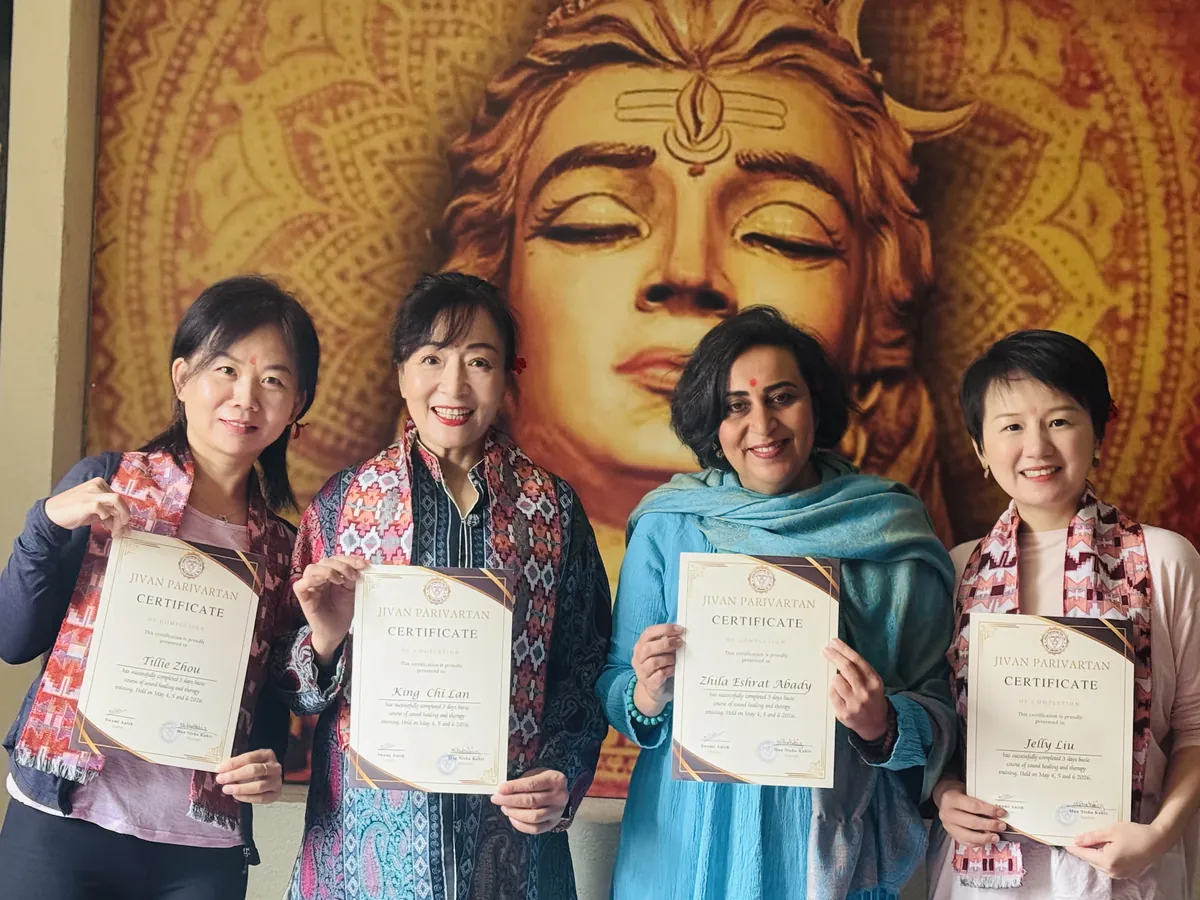
Maa Nisha Kabir teaches Usui Reiki at our centre in Kathmandu. She trained in Reiki in 2017 and has taught it here since 2021, to 70+ students. Maa Nisha Kabir's Reiki background is on our About page, and we will add her full chain of teachers here when it is confirmed in writing. If you need it before you book, ask us when you enquire.
Our Usui Reiki training in Nepal is taught in three levels, and at Reiki Master training you learn what it means to pass the line on to students of your own.
Frequently asked questions
Which country does Reiki come from?
Japan. Mikao Usui began teaching it in Tokyo in 1922, and it reached the West through Hawaii from the mid-1930s.
Is Usui Reiki the original Reiki?
Usui Reiki is the Reiki that Mikao Usui taught, and the source of almost every style taught today. Other healing methods called reiki existed in Japan at the same time, but they are separate methods.
Do I need to know my lineage to practise Reiki?
Not to practise for yourself. It matters if you want to register with a professional body, or to teach, since your students will ask for it.